Quick Look
• Barlow penned his bold and controversial take on the future of the Internet 30 years ago.
• Many of Barlow's predictions about the capabilities of the Internet to remain free have not panned out and unforseen threats have cropped up.
• But, it's hard not to feel his central thesis can still be achieved—though perhaps, only if you chose it.
Now, three decades later, as the Internet has come to dominate our lives and is in a crucial period of transition, it's a good time to reflect on Barlow's early vision of the Internet and how it might guide the Internet's future.
There are, no doubt, many parts of his declaration that simply haven't come true, but I can't help thinking that the spirit of Barlow's message can be achieved—at least for those who might be willing to seize it.
A Declaration of the Independence of Cyberspace by John Perry Barlow, February 8, 1996
Quick Look
• The FBI raid on Washington Post reporter’s home shows uncertainty about biometrics under the Fifth Amendment.
• Hannah Natanson was compelled to unlock a MacBook with her fingerprint.
• Until the law is clarified, use PINs/passwords instead of biometrics.
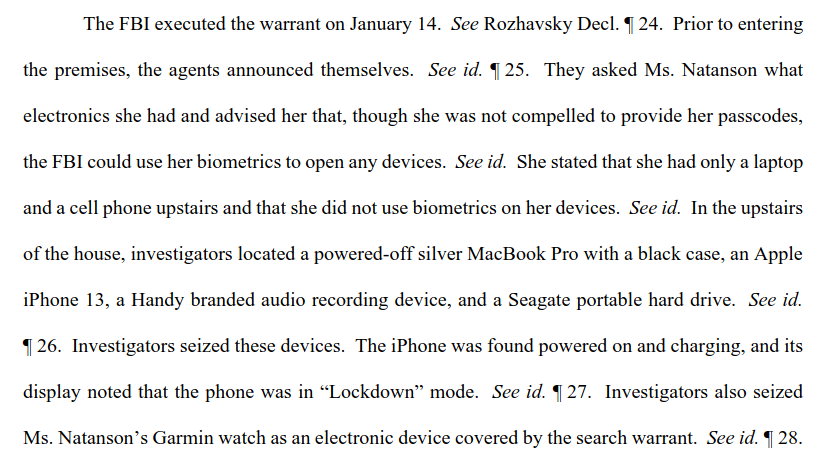
While much ink has been spilled about the potential chilling effect the raid on Natanson's home may have, some key details of the search are now coming to light.
Authorities seized several devices from Natanson's home
Authorities seized several devices from Natanson's home during the January 14th raid
In court filings, the federal government has now detailed the devices seized from Natanson's home, which included two laptops, a cell phone, an audio recorder, a hard drive, and a smartwatch.
There is a saying in cryptocurrency: “not your keys; not your coins.”
In essence, if you don't control the keys to the wallet containing the cryptocurrency—usually a series of random words generated at the time that the wallet is created—then you don't really own the money inside it.
It's the difference between having your money in a bank that actually possesses your cash and lets you access it, or in an impenetrable safe where only you know the combination. If you possess the cash and the safe, you truly own the money.
There are a lot of positives to using biometrics on your devices. It's hard to deny their convenience and in some ways, avoiding passwords can be a good thing since they can be forgotten or stolen.
But the law doesn't necessarily treat your fingerprint the same as a PIN code or password when it comes to unlocking your device. This means you could be compelled to unlock your phone or computer depending on which unlock method you use.
Stay up to date with the writing and advocacy of the Decent Project by entering your e-mail below.
New posts will arrive directly in your e-mail inbox with no click-tracking or hidden pixels.
Thank you!
RSS
You can also subscribe via RSS.
If you're a fan of self-hosting, FreshRss is a great option.
The RSS link above will subscribe to all posts. However, if you're interested in specific content, such as privacy-, legal-, or advocacy-related posts only, then you narrow your RSS subscription by including the relevant hashtag after the RSS URL.
Started in 2025, the Decent Project promotes privacy, autonomy, and civil liberties by advocating for a decentralized web, privacy rights, and an open internet. Read our Mission Statement here.
The project is currently focused on outreach and education, primarily through this blog.
Please consider subscribing to stay informed as we publish new posts and expand our efforts.
Thanks!
Mission Statement
The Decent Project promotes individual privacy and civil liberties by advocating for robust, privacy-preserving laws and challenging government and commercial intrusions. We strive to empower individual self-determination and autonomy through:
Advocacy: Promoting decentralization of web services, Web3 adoption, blockchain technology development, and cryptocurrency integration.
Free expression and open internet: Safeguarding freedom of expression and advocating for an open, accessible internet.
Policy reform: Pushing for sensible legislation that prioritizes data privacy, AI, and opposing monopolistic practices.
By addressing these interconnected areas, The Decent Project works to create a digital environment that respects and protects individual rights and freedoms.
The Decent Project advocates for:
Decentralization of web services
Web3
Development of blockchain technology
Cryptocurrency adoption
Freedom of expression
Open Internet
Sensible legislation around data privacy and AI
Anti-monopoly
Free and open source software
(Planned) Areas of engagement:
Litigation:
Challenging unconstitutional legislation or policies that threaten individual liberties and privacy rights.
Challenging monopolistic companies that are predicated upon and propped up by the collection, sharing of personal data.
Advocacy:
Working with lawmakers to introduce sensible privacy laws in the digital age.
Working with companies and organization to improve data collection policies in a way that benefits commerce and individuals.
Working with companies to improve transparency of their privacy policies.
Working with companies to empower their customers to make choices about how their data is collected and used.
Supporting and advocating for free and open source software.
Supporting and advocating for development of the blockchain and Web3.
Working to increase the convenience of pro-privacy tools and software.
Organization
Organizing individuals to push for legal, policy, and commercial privacy reforms.
Working to educate people about the impacts of modern data collection policies and why privacy matters.
Working to empower individuals to make their
Working to educate individuals about steps they can take in order to improve their privacy.
Fighting against the surrendering and defeatist mindset that many people have about privacy and its role in the Internet-era.
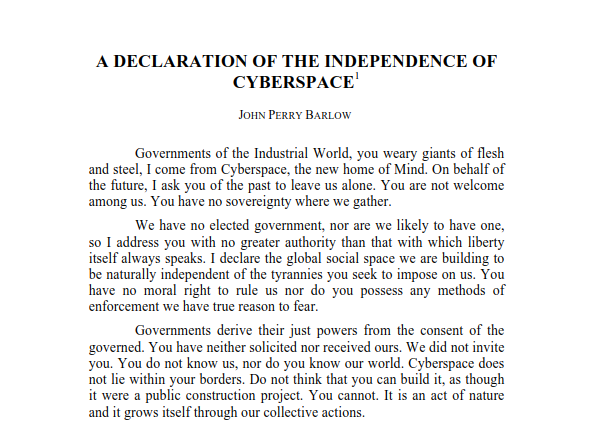 A Declaration of the Independence of Cyberspace by John Perry Barlow, February 8, 1996