It's been 30 years since Barlow's Declaration of Cyber Independence — does it still matter?
Quick Look • Barlow penned his bold and controversial take on the future of the Internet 30 years ago. • Many of Barlow's predictions about the capabilities of the Internet to remain free have not panned out and unforseen threats have cropped up. • But, it's hard not to feel his central thesis can still be achieved—though perhaps, only if you chose it.
Today marks 30 years since John Perry Barlow—co-founder of the Electronic Frontier Foundation—opened his laptop at the 1996 Economic World Forum in Davos and penned an unforgiving declaration of independence for the Internet.
Now, three decades later, as the Internet has come to dominate our lives and is in a crucial period of transition, it's a good time to reflect on Barlow's early vision of the Internet and how it might guide the Internet's future.
There are, no doubt, many parts of his declaration that simply haven't come true, but I can't help thinking that the spirit of Barlow's message can be achieved—at least for those who might be willing to seize it.
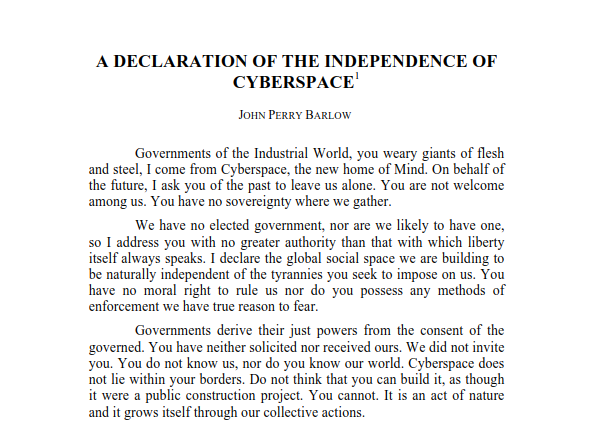 A Declaration of the Independence of Cyberspace by John Perry Barlow, February 8, 1996
Barlow's Declaration
There are a lot of ways to describe Barlow's A Declaration of the Independence of Cyberspace.
Lofty, inspiring, and courageous might come to mind. But so might pompous, blow-hard, specious and grandiloquent.
When Barlow wrote his declaration, the Internet was a very different place. Most homes, if they had computers at all, put them in “computer rooms.” The idea that every individual would have their own computer—let alone multiple—connected to the Internet at all times wasn't yet a thing. Total Internet users were counted in the millions, rather than billions.
Google had not yet been founded, and social media, cryptocurrency, and generative AI were many years away.
Yet, Barlow made bold declarations about the capabilities of cyberspace to flourish, and governments' inability to contain it:
“You have no moral right to rule us nor do you possess any methods of enforcement we have true reason to fear.”
He claims that cyberspace exists without borders and outside jurisdictions:
“Our identities may be distributed across many of your jurisdictions. The only law that all our constituent cultures would generally recognize is the Golden Rule.”
While in spirit, some of these declarations may be true. I think most would disagree with Barlow's claim that governments do not possess “any” methods of enforcing their laws on the Internet, and that because users are distributed around the globe that jurisdictions are rendered meaningless.
Governments around the world have spent the last three decades working to reign in the Internet and enforce laws on its users. In China, the country's Great Firewall heavily regulates the country's domestic Internet. Iran recently disconnected its country from the world's Internet amid widespread protests.
And in the West, the United States and Europe have been on foolhardy campaigns to institute age verification laws, crackdown on VPNs, and backdoor end-to-end encryption on popular messaging services.
The United States has incredible influence to enforce its criminal laws concerning computer crimes well beyond its geographic borders.
Alexandre Cazes of notorious AlphaBay fame was arrested in Thailand, while Kim Dotcom of Megaupload was arrested in New Zealand—both on U.S. warrants. Julian Assange spent seven years in the Ecuadorian Embassy in London to avoid arrest by the U.S. and other western countries, and Edward Snowden fled to Russia in 2013 to avoid prosecution.
Additionally, Barlow's declaration did not predict the considation of the Internet and how that has impacted online freedom.
Over the past 30 years we have seen the giants of the Internet rise and take hold: Google, Meta, Apple, Microsoft, X/Twitter, and Amazon.
They operate as proxy governments online, enforcing terms of service and privacy policies that limit expression and pry into every aspect of our lives.
They have disrupted industries in the real world and online, baited our society and culture with “free” services, and sunk their tentacles into our communications, our jobs, our banking, our health, our entertainment, and even our frontdoors and living rooms.
Digital town squares and convenience have given way to hive-minds and dependence.
But for those who want it...
In re-reading Barlow's declaration today, it's hard not to question whether there remains the kind of freedom online that Barlow describes.
There are threats to Internet freedom on all sides, as society moves into this post-modern era we find ourselves.
Yet, I can't help but agree with Barlow's claim that the Internet is “an act of nature and it grows itself through our collective actions.”
In Iran, as the government shut down access to the Internet, people started setting up Starlink connections to reach the global Internet; people in China have used VPNs and international SIM cards to circumvent the country's firewall for years; and age restriction laws in the United States are easily avoided with a VPN or TOR browser.
The more restrictions that governments attempt, the more they push people toward alternatives.
The same goes for corporations.
Some have sought refuge from Microsoft's unwanted and invasive AI features by moving to Linux. Others have ditched Google for Proton or Tuta. Others still, have left behind centralized social media for the Fediverse.
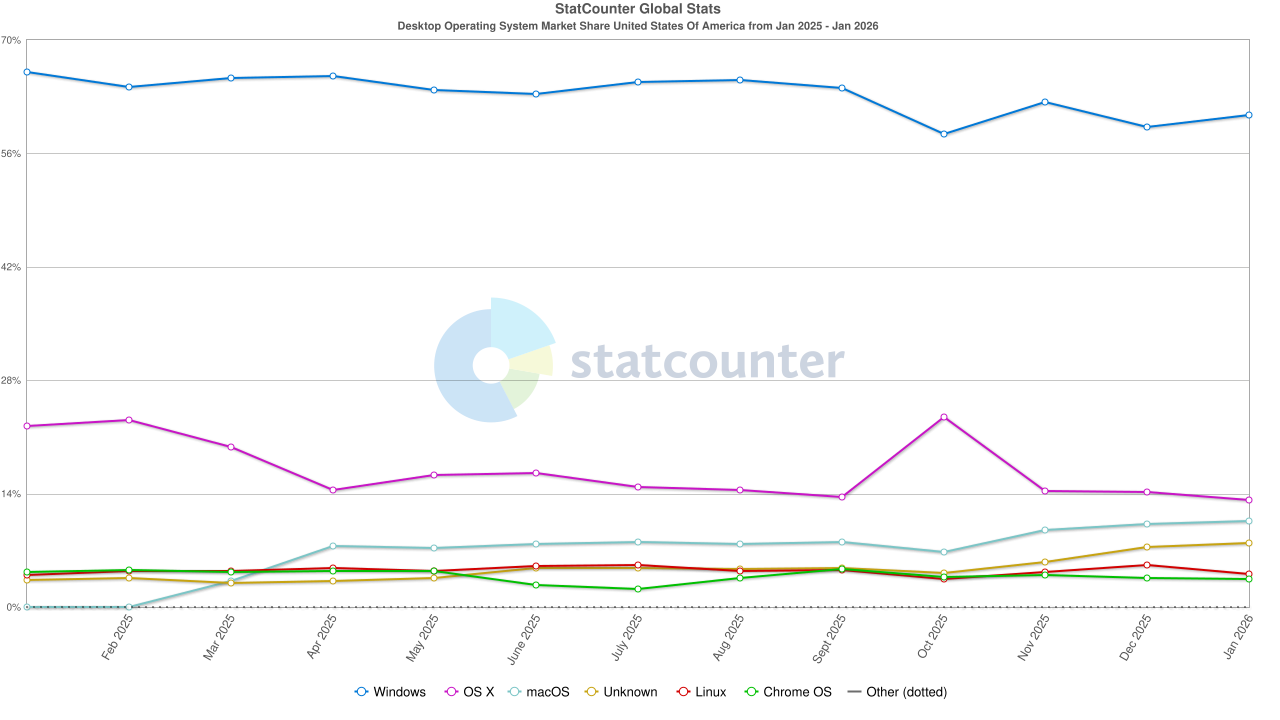 Linux desktop usage topped 5% globally in 2025
An unheeded plea
We have to ask whether Barlow's declaration is really a declaration, or is it more of a plea?
The second sentence of his declaration is a request: “I ask you of the past to leave us alone.”
Unfortunately, I think it's safe to say this plea has not—and will not—be respected. Governments are not going to step away from the Internet and corporations are not going stop maximizing their control and revenue.
Yet, for those who are willing to break free from governments and the centralized control of corporations online, there are still ways to make the best of Barlow's vision a reality:
“We are creating a world where anyone, anywhere may express his or her beliefs, no matter how singular, without fear of being coerced into silence or conformity.”
~ Torman
Verify this post: Source | Signature | PGP Key
#privacy #Internet #policy #InternetFreedom
If you enjoyed reading this or found it informative, please consider subscribing in order to receive posts directly to your inbox:
Also feel free to leave a comment here: Discuss...